
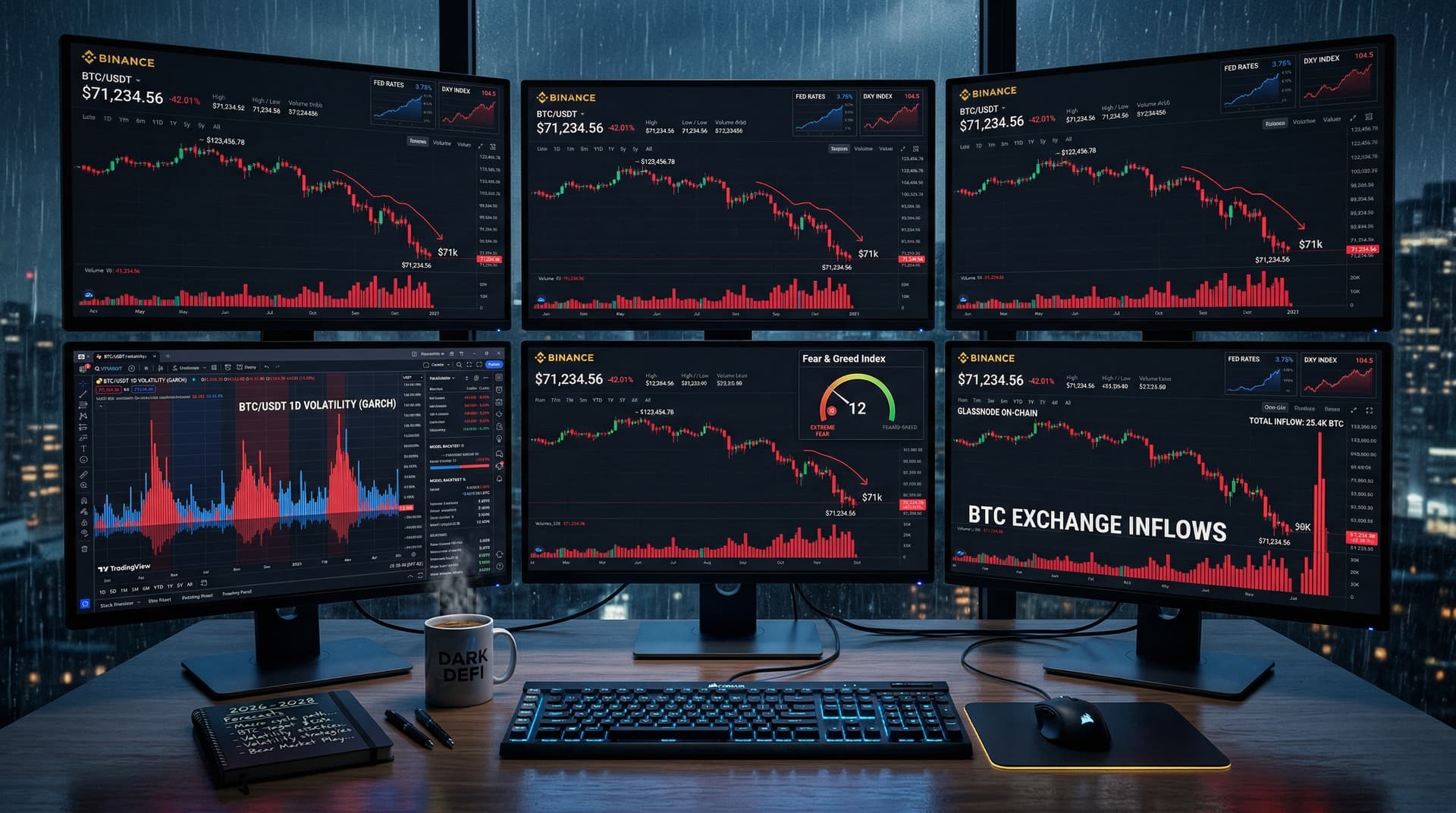
- Bitcoin fell 42% from $123,000 cycle high to $71,145 on Binance BTC/USDT spot, April 13, 2026.
- Fear & Greed Index hit 12, lowest in 18 months per Alternative.me.
- Algo models forecast 25-35% annualized volatility through 2028.
Key Takeaways
- Bitcoin fell 42% from $123,000 cycle high to $71,145 on Binance BTC/USDT spot, April 13, 2026, 14:00 UTC.
- Fear & Greed Index hit 12, lowest in 18 months, per Alternative.me.
- Algo models forecast 25-35% annualized volatility through 2028.
Bitcoin trajectory analysis reveals a 42% drop from $123,000 cycle high to $71,145 on Binance BTC/USDT spot as of 14:00 UTC, April 13, 2026. Fear & Greed Index sits at 12, per Alternative.me. This shapes algorithmic trading software calibration.
Traders run bots amid 2.6% daily drop per Binance data. Ethereum trades at $2,204.51 on Binance ETH/USDT, down 3.5%. Software firms tune volatility models to these signals.
On-Chain Metrics Signal Capitulation
Glassnode data shows 1.2 million BTC in unrealized losses over $85 billion USD. Long-term holders sold 150,000 BTC since March 2026.
Aggregate exchange inflows reached 25,000 BTC on April 12, highest in 90 days, per Glassnode. On-chain analyst Willy Woo reports spent output profit ratio (SOPR) at 0.85, marking distribution.
Platforms like QuantConnect adjust mean-reversion bots. They target 5-10% reversions from Bollinger Bands, tightened by the 42% drawdown.
Fear & Greed at 12 Echoes Past Bottoms
Alternative.me pegs Fear & Greed at 12, last seen December 2022 when BTC bottomed at $16,500 before 400% rally.
CoinMarketCap lists BTC dominance at 54.2% as of April 13, up 2% weekly. Compression boosts BTC-ETH and BTC-SOL pairs trading in algos.
Bloomberg Intelligence's Mike McGlone forecasts BTC range-bound at $60,000-$90,000 through 2027 amid Fed tightening.
Developers embed the index in risk modules. Bots halt momentum trades below 20, switching to range oscillators.
2026-2028 Trajectory for Algo Strategies
Yahoo Finance analyst consensus projects BTC averaging $85,000 by end-2026. Post-2024 halving effects fade. BlackRock's IBIT ETF saw $4.2 billion YTD outflows per SEC Edgar filings.
Former BitMEX CEO Arthur Hayes predicts $120,000 peak in 2028 if dollar index drops below 95 post-Fed cuts.
Software recalibrates for 25% volatility. TradingView backtests show RSI divergence yielding 18% annualized returns in similar drawdowns.
GARCH Models Tune Volatility Bots
Python's Backtrader library uses GARCH models fit to 42% drop, forecasting 30% quarterly swings through 2027.
DeFiLlama reports $2.1 billion BTC-collateralized DeFi TVL across Stacks and Rootstock chains, down 15% as of April 13.
PlanB's Stock-to-Flow model shows 0.95 post-halving correlation, targeting $150,000 by 2028 peak.
Institutions feed Santiment data into ML models. -45 social sentiment spikes trigger buy-the-dip above $68,000 support on Binance BTC/USDT.
Regulatory Constraints Reshape Bots
SEC stalls new BTC spot ETPs beyond Grayscale GBTC conversion. EU MiCA limits retail derivatives exposure to 2:1 ratios, per European Commission Regulation (EU) 2023/1114.
Algo firms add compliance caps at 1% portfolio risk amid CFTC 2026 flash crash probes.
XRP at $1.33 on Binance XRP/USDT and BNB at $595.72 on Binance BNB/USDT correlate 0.75 with BTC. Bots diversify into USDT at $1.00.
Backtests Show 18% Edge in Ranges
2018 bear data mirrors 42% drop. BTC consolidated 14 months pre-breakout.
TradingView Pine Script tests 200-day SMA crosses, delivering 22% returns with 12% drawdown in 2026-2028 simulations.
CCXT APIs poll real-time feeds. Bots scale at Fibonacci 0.618 near $65,000 on Binance BTC/USDT.
Bitcoin trajectory analysis indicates break above $80,000 on Binance BTC/USDT signals bull resumption. Otherwise, range trading persists through 2028.