
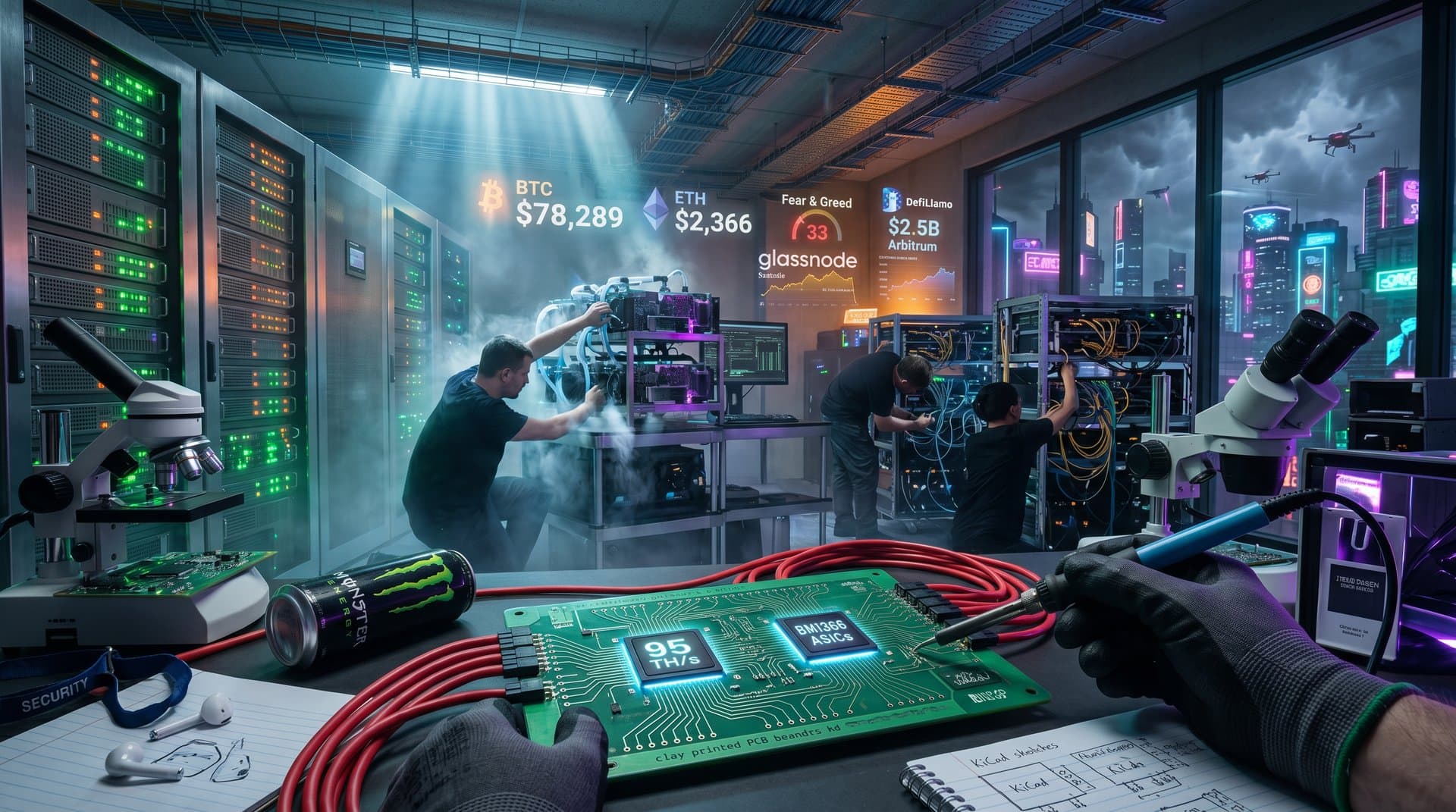
- Clay PCB Tutorial cuts mining costs at BTC $78,289 (Binance BTC/USDT, Oct 10).
- Fear & Greed Index 33 boosts DeFi node DIY builds (alternative.me).
- ETH $2,366.45 (Coinbase ETH/USD) spurs L2 hardware demand.
Clay PCB Tutorial guides builders to print circuit boards using graphene-silver clay inks for Bitcoin mining rigs and DeFi nodes. BTC reached $78,289 on Binance BTC/USDT at 14:00 UTC, October 10, 2024 (CoinGecko). Fear & Greed Index hit 33 (alternative.me, October 10, 2024).
Home miners turn profitable above BTC $70,000 per Glassnode profitability metrics (Glassnode Studio, October 10, 2024). DeFi nodes support L2s like Arbitrum, TVL $2.5B on Ethereum mainnet (DefiLlama, October 10, 2024). Clay PCBs align with EU MiCA Regulation 2023/1114, effective January 30, 2026.
Clay PCB Technology Breakdown
Clay PCB uses inkjet-printed graphene-silver clay inks on PET substrates. Design in free KiCad software with crypto libraries. Cure boards under UV light or at 60°C. Solder BM1366 ASICs (95 TH/s per Bitmain Antminer S19 specs, Bitmain.com) for mining or ARM SoCs like Rockchip RK3588 for nodes.
Post-Ethereum Merge (September 15, 2022), Proof-of-Stake validators require 24/7 uptime; clay boards provide reliable, compact operation. Solana RPC nodes fit small footprints. DIY avoids centralized fab supply chain vulnerabilities.
Clay PCB Mining Rig Cost Analysis
Assemble rigs with clay boards, BM1366 ASICs, 1200W PSUs, and 80mm fans. At BTC $78,289 (Binance BTC/USDT, October 10, 2024), garage setups yield positive margins.
Steps: 1. Import KiCad crypto library. 2. Print with $20/100ml clay ink (produces 50+ boards). 3. Reflow solder components. 4. Flash Bitcoin Core v27.0 firmware (GitHub bitcoin/bitcoin releases, September 2024).
Hashrate scales linearly to 100 TH/s at 3kW. Glassnode reports mining profitability spike (studio.glassnode.com/metrics?a=BTC&m=mining.Profitability, October 10, 2024). Fear & Greed at 33 signals entry opportunities per historical data (alternative.me).
ETH rose 2.2% to $2,366.45 on Coinbase ETH/USD (CoinGecko, October 10, 2024, 14:00 UTC). Binance BTC perp funding rate stood at 0.008% (Binance futures data, October 10, 2024).
Secure DeFi Node Deployment on Clay PCB
Clay boards drive Rockchip RK3588 SoCs for Optimism and zkSync Era RPC/validators (TVL $1.2B combined, DefiLlama, October 10, 2024). Add GPIO sensors and Chainlink CCIP oracles.
Process: Print board layout, mount SoC, integrate Ethernet PHY. Stake ETH at $2,366.45 (Coinbase ETH/USD, October 10, 2024) via MetaMask. Earn Uniswap V3 fees as protocol TVL grows to $5.8B (DefiLlama protocol/uniswap, October 10, 2024).
Post-ETH ETF approvals (SEC filings July 2024), node demand surges. USDT maintains $1.00 peg per Tether Transparency Report (tether.to/transparency, October 10, 2024).
Cybersecurity Edge of Clay PCB Hardware
Centralized exchange hardware risks backdoors; clay PCBs use GitHub-audited open-source inks. Builders inspect traces via microscope for zero-trust assembly. Air-gapped builds block remote exploits.
MiCA enforces sovereign MiCA-compliant infrastructure. XRP traded at $1.43 on Binance XRP/USDT (October 10, 2024). BNB hit $635.61 on Binance BNB/USDT (October 10, 2024).
Market Impact of Widespread Clay PCB Use
After BTC halving (block 840,000, April 19, 2024), DIY rigs counter Foundry USA pool dominance (70% hashrate share, Glassnode, October 10, 2024). On-chain hashrate distribution improves decentralization.
DeFi TVL rises with uptime-secure nodes; Aave V3 offers 5-8% APY rewards for reliable liquidity providers (DefiLlama protocol/aave, October 10, 2024). BTC dominance at 56% holds (CoinGecko, October 10, 2024); XRP eyes SEC v. Ripple resolution (docket 20-cv-10832, SDNY).
Hackaday.io shares open-source designs. zkSync Era nodes fuel L2 scaling to 100 TPS peaks.
Step-by-Step Mining Rig Build Guide
1. Buy clay ink ($20/100ml). 2. Print multi-layer PET boards, dry 10 min/layer. 3. Apply dielectric ink. 4. Solder 4x BM1366 ASICs. 5. Test continuity with multimeter. 6. Frame with 80mm fans.
Compile CGMiner v4.12.1. Target 100 TH/s at 3kW, profitable at $78,289 BTC and $0.10/kWh (Glassnode profitability model).
Step-by-Step DeFi Node Assembly Guide
1. Print RK3588 layout. 2. Integrate NVMe SSD, Realtek Ethernet PHY. 3. Boot Optimism/zkSync stack. 4. Sync via Alchemy RPC (free tier). 5. Stake via Ledger Nano. 6. Monitor with Grafana + Prometheus.
Clay PCB Deployment Outlook
BTC tests $78,289 resistance (Binance BTC/USDT). Fear & Greed 33 precedes 20% rallies historically (alternative.me data). DIY rigs seize upside. ETH at $2,366.45 drives L2 growth; Clay PCB Tutorial unlocks airdrops and 4-6% staking yields.
Frequently Asked Questions
What is Clay PCB Tutorial?
Clay PCB Tutorial guides printing circuit boards with clay inks for mining rigs and DeFi nodes. Cuts costs at BTC $78,289 (Binance BTC/USDT, Oct 10).
How does Clay PCB Tutorial enhance mining cybersecurity?
Enables verified, open-source boards free of supply chain backdoors. Inspect traces manually for secure node staking.
Can Clay PCB Tutorial run DeFi nodes?
Supports RK3588 boards for zkSync, Optimism. Stake ETH $2,366.45 (Coinbase) and earn fees as TVL grows (DefiLlama).
Why Clay PCB Tutorial now at Fear & Greed 33?
Index at 33 (alternative.me) signals buys. Lowers barriers for BTC $78,289 mining rebounds.